
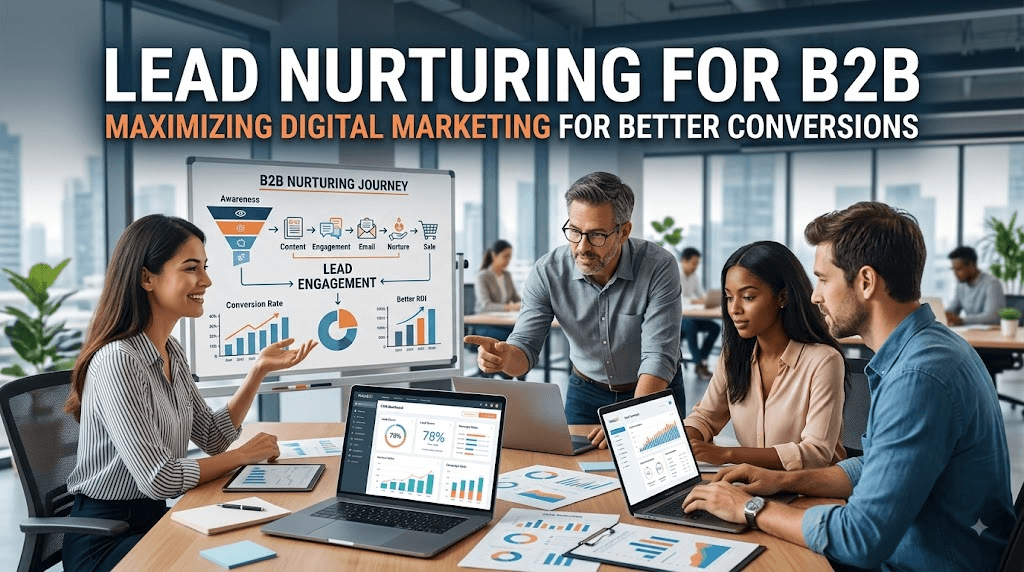
Lead Nurturing for B2B: Maximizing Digital Marketing for Better Conversions
Introduction:
In the ever-evolving digital world, the B2B landscape is essential in generating and nurturing leads into loyal customers. The loyal customers are no longer only about the good or trustable products and services. It's about building a meaningful relationship with the customers. This helps you connect with your customers or buyers on a personal level, where the perception changes to how they see you less as a business that wants more money and as a person who wants to help you with their product and service. Lead Nurturing through digital marketing for B2B businesses plays a crucial role in generating leads. Here's how you can maximize your efforts in leads to boost conversions. Let's delve into it:
Table of Contents
- What is Lead Nurturing
- How important is Lead Nurturing for B2B Companies
- What does it take to create a perfect Lead Nurturing Plan
- Tools used for Lead Nurturing
- Key Components of Effective Lead Nurturing Strategies
- What is B2B Marketing
- What are the Benefits of B2B Marketing
- Types of B2B Marketing
- Conclusion
What is Lead Nurturing?
Lead Nurturing might sound like a complex term. It is said to be the process of building a relationship with potential customers throughout the journey. In general, Lead Nurturing aims to generate prospects for buying products and services by providing necessary information, solving problems, and explaining the value of the products and services. It is a process of engaging and developing relationships with potential buyers for different levels of a sales funnel. This helps in improving the chance of increasing sales, by guiding them towards making a decision. Eventually, you ought to build relationships with your prospects that are more likely to be useful and bring better results.
How important is Lead Nurturing for B2B Companies:
Why is lead nurturing important? In simple terms, Lead Nurturing is important for B2B companies as most leads don't convert to potential customers immediately. Visitors to your page may take some time to gather information, compare options, or right time to act. This doesn't happen without consistent engagement, as the visitors may forget your brand and its product or services. Lead Nurturing keeps reminding your visitors and prospects at the top of their minds while addressing their pain points. With a perfect lead nurturing strategy, one can achieve the desired results and make it more responsive than ever. Lead Nurturing has the potential to increase your ROI and simplify your sales cycle.
What does it take to create a perfect Lead Nurturing plan?
It is not very critical, or rocket science to create a perfect Lead Nurturing Plan. It is easy to plan, execute and optimize a lead nurturing plan, but it needs to be constantly monitored at certain levels. A/B testing should be done to create a proper framework that would convert the prospects into returning customers. Here is a list of lead nurturing phases that ensure a smooth transition to leads of potential customers.
Define and Categorize your leads - Initially define your audience based on the customer profile. By analyzing different customer profiles, marketing teams can easily tailor different strategies in a way that looks appealing and serves highly targeted content.
Segment and Score your Leads - Now that you have identified the buyer persona, it's time to break them down into data points and segment them accordingly. Focus on a balanced segmenting and sub-segmented approach that helps you understand the behavioral patterns instead of creating a complex framework with complex customers. This helps score the leads using different criteria.
Create your Nurturing content - Based on the customer segments and different deal points created, set up your content and message and decide how you want them to be conveyed to your leads.
Optimize your lead Nurturing Content - Lead Nurturing is a continuous process that must be monitored, tested and optimized to ensure the effectiveness of the campaigns. With proper testing, one can review the customer insights and nurture more leads by frequent tracking and optimizing at different touch points.
Tools used for Lead Nurturing?
Various tools used for Lead Nurturing include:
Email Marketing Platforms:
In recent years, Email marketing campaigns have been widely used for Lead Nurturing. This includes various advantages, marketers can overview the performance at regular intervals using the automated tracking facilities that help in tracking and monitoring the leads.
CRM Systems:
Nowadays, CRM has become a powerful tool in Lead Nurturing, It helps generate more new leads for your business while keeping your old customers engaging and happy. They also have immense potential to generate more leads. You can turn your CRM into a lead nurturing machine by collecting, analyzing and organizing customer data and prospects to convert them into leads by successfully following and automating your communication.
Marketing Automation:
Follow the below guidelines to do an impactful Marketing Automation for your business:
- Automate your marketing messages that have to be sent to your prospects and potential customers on important dates.
- Create different strategies for different customer segments, based on their needs.
- Lead scoring helps with lead nurturing
- Use marketing automation to improve your customer segmentation
- Link your CRM systems with marketing automation
- Don't give up on difficult leads
Content Management Systems:
Content Management System is nothing but, creating relevant and compelling content that captures the interests of your target audience or potential leads. This helps your customers guide them through the buying process of your product and services. The transition stage happens from awareness to consideration and ultimately to conversions.
Whatsapp Marketing:
Whatsapp Marketing helps business to streamline their lead nurturing process. WhatsApp can help you create meaningful connections with your audience by sending marketing messages. This platform allows you to interact using AI bot and CRM systems, enabling automated follow-ups, and personalized messages with automated messages.
Key Components of Effective Lead Nurturing Strategies
Effective lead nurturing strategies rely on several critical components, Let's uncover those for better understanding:
Personalized Interactions:
Keep your interactions at a personal level, with your customers or target audience. This makes them feel that you are concerned and show up to their interest levels. Personalization shows leads that you can understand their specific needs. For Instance, if you notice your leads showing interest or making activity like downloads, follow up by providing insights with your sources.
Active and Timely Follow-Ups:
Active and Timely Follow-up might sound simple, but it has a vast impact on your lead generation. Initiate engaging with your leads after they interact with your content. Studies show that responding within 24 hours of interaction increases engagement rates. So have a timely and relevant follow-up with your lead's interest.
Educational Content:
Keeping your leads updated by sharing knowledge showcases your brand as a trusted advisor. Use resources like blogs, posts and webinars to educate your audience. Podcasts also help in educating your audience about your brand and business. For Instance, sharing a successful B2B advertising campaign and strategies that are followed, can attract leads with confidence towards your brand.
Multi-Channel Outreach:
As the name suggests, do nurture your audience or leads through various channels, don't limit yourself with one platform. As we all know LinkedIn is a powerful tool, combining it with email marketing, social media and offline campaigns creates multiple touch points and will prove to be a better lead-nurturing strategy that drives more results.
Note: By combining personalized interactions, Active and Timely follow-ups, Educational Content and Multi-Channel Outreach which remains a proper Lead Nurturing Strategy, every business can attain the maximum number of lead conversions, which feels genuine and effective with less effort and maximum impact.
What is Digital Marketing for B2B Business?
B2B Marketing is a process of building relationships between businesses and potential customers with the aim of converting their final interests towards making their purchase. B2B digital marketing tactics aim to share awareness about the names, services, and offerings of other businesses. Every business should craft strategies to sell their products or services to other businesses. Like other B2C marketing strategies that target individual customers, B2B marketing focuses on engaging other companies. This approach demands unique techniques and strategies with priority. Every company has to have a different strategy in marketing plans in order to reach the customers.
B2B marketing is very important as every business relies on at least one other business to help them operate and grow.
What are the Benefits of B2B Digital Marketing?
As mentioned digital marketing strategy for a b2b company is all about building relationships with your customers. Structuring a strong B2B marketing plan seems to be an investment of time and resources. This needs to be checked on frequently. This might sound difficult and time consuming, but it is worth it to do. The time and energy you spend establishing and maintaining your marketing plan will pay you genuinely with both long-term and short-term benefits.
The benefits of a B2B Digital Marketing strategy include:
- Generate Leads - Beneficially, the large impact you will have on your business with digital marketing includes increasing your leads, which in turn is higher conversion rates and more sales.
- Expand Brand Awareness - There are many ways to expand brand awareness, but being more creative and compelling with your content, and being consistent with it helps you reach heights. Focusing on localized strategies plays a role. Marketing efforts, particularly consistent and diverse ones, help build awareness around your brand and also establish your authority as an expert.
- Improve Rankings - Improving your brand rankings in Google can be done by matching your content with search intent. But people nowadays don't get time to sort through all their options, that is where Google helps in sorting down their choices. B2B marketing helps you stay ahead of the competition and rank at the top with higher visibility.
- Increase Traffic - An improved ranking means an increase in traffic. When your content ranks high in the search engine it means an automatic increase in traffic takes place. This helps gain attention towards your website and social media channels to capture the opportunities of seeking attention and engaging with your target audience.
- Build Relationships - No matter how much AI evolves, customers still want a human touch, particularly in the B2B space. Building and maintaining relationships is a crucial aspect of any business, and where market strategy plays an important role in doing just that.
Types of B2B Digital Marketing:
Whatever the business tactics or strategies may be for the business, the buyer's journey will be the same across the brands. However, B2B marketing typically seems difficult when compared to marketing, as it involves a longer sales cycle and often requires a more personalized approach.
B2B Email Marketing:
Despite being around for a long term, Email marketing is still an effective strategy for generating leads, nurturing leads and relationships to build a longer term relationship. Email marketing in B2B business helps businesses to promote and share their offerings with other businesses and is often a priority in businesses. This strategy may date back to the olden days, but it works efficiently to generate leads and nurture those.
B2B Digital Marketing:
B2B digital marketing is a marketing strategy in businesses that use digital mediums to market their products or services to other businesses. It doesn't matter what product or service you are selling, or to what resource you are selling it, you must have an active social media presence. Irrespective of the platform in social media, you business page should be authentic and genuine with creative content in order to help establish your business into authenticity. So by providing creative and engaging content, you will showcase your business knows how to keep your customers engaged with followers and to have fun.
B2B Content Marketing:
B2B content marketing is all about creating and distributing content to earn the attention of other businesses. This helps ultimately the visitors into loyal customers. Some of the most popular B2B content marketing sources include blog posts, white papers, templates, case studies, videos, webinars and podcasts. The content posted in these formats is generally to educate and inform your target audience, ultimately increasing the conversion rates and sales.
Tip: The secret behind all B2B digital marketing strategies is that the content needs to be creative and relevant that is beneficial and useful to the target audience or potential customers.
Conclusion:
By following these guidelines and strategies, every B2B business can establish and accomplish structured marketing with an effective lead nurturing process. This approach makes sure your leads are properly guided, nurtured with relevant content, and targeted through the sales funnel. Eventually, this helps with an increase in conversion rate and driving business growth. Technology keeps evolving every day, so all small and large businesses should keep adapting, where Lead Nurturing in B2B marketing strategy makes it easier to stay ahead in the competition with creative, relevant and interesting content that your target audience is searching for. Keep your adjustments constant, don't stick to the well-known strategy that works well for you, in order to stay as flexible as possible.
Frequently Asked Questions on B2B Lead Nurturing:
What are the Lead Nurturing Campaigns?
Lead Nurturing Campaigns are those that are designed carefully, but are often automated initiatives like bots or automated timely reminders that brands use to reach and build relationships with the target audience. Nurturing campaigns are executed across a variety of channels and touchpoints, including emails, social media, blogs, events and ads. This helps in providing value and is a step towards converting leads to conversion rate.
How do you create personalized Lead Nurturing Content?
Personalized Lead Nurturing content can be built by identifying your customers, and segregation them into group customer segments. Based on the customer segments and different deal points created, set up your content and message and decide how you want them to be conveyed to your leads. So tailor your content to address specific audience needs and behaviors, focusing on their pain points.
What are the 4Cs of B2B Marketing?
The 4Cs of B2B business marketing include
- Content - The creation of a proper stream of engaging content
- Connection - Connecting with your audience to interact with them
- Communication - Communicating with them in an ongoing conversation
- Conversion - converting them at the illusive moment of the need.
Blending these four strategies or techniques together helps businesses build a strong foundation for their business strategy.
What is Lead Scoring?
Lead Scoring helps you to identify the value of the leads which it assigns points to the prospects based on the level of sales readiness and interest they demonstrate through various actions like clicking the CTAs, opening the email links, content downloads, and signups for events or podcasts. High-scoring leads are prioritized for immediate sales outreach while low-scoring leads need to be nurtured to warm them up.
What is Lead Qualification?
In general Lead Qualification is the process of evaluating leads. This process helps in ensuring that your prospects match the characteristics of your ideal customer profile. Lead scoring assigns a score to the leads when they are brought into the sales funnel. Qualified leads need further nurturing and sales follow-up actions, depending on what category they fall into.