Quick Takeaways
-
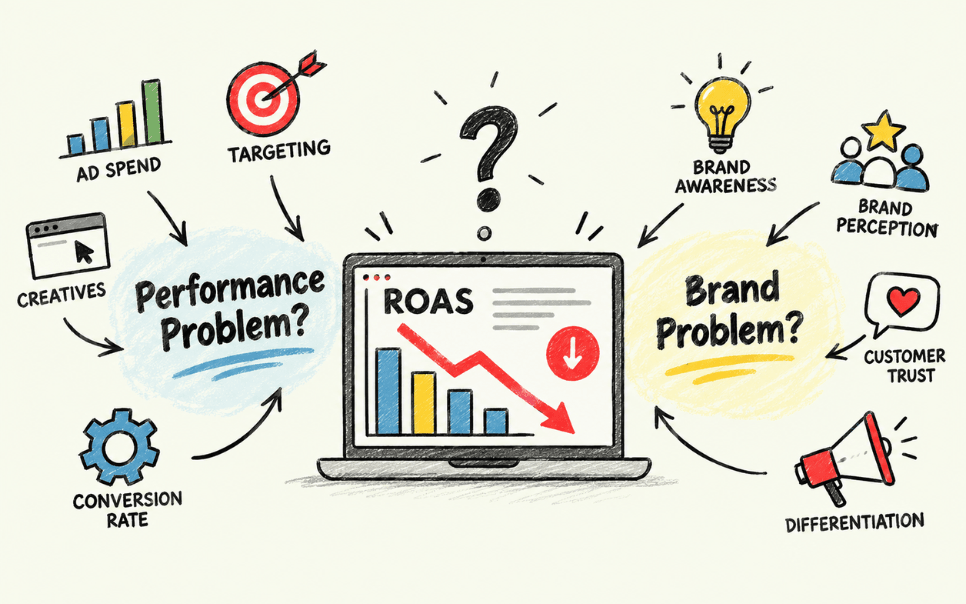
There are two entirely different causes for ROAS going down: performance execution (creative fatigue, tracking, targeting) or brand (nobody knows you, so cold traffic will not convert).
-
Look into performance first, and then brand. Performance-related issues are easier and cheaper to address.
-
A combination of increasing CAC and steady brand search volume is the clearest sign that it is a brand, not a performance, issue.
-
The median ROAS of Meta Ads in 2026 is estimated at 1.9x–2.2x globally, which means that a “low” number could be a regular one for your category.
-
In 2026, the optimal method for enhancing ROAS would no longer be merely reducing the budget. The first step would be to pinpoint the source of inefficiency and fix it.
Last quarter, your dashboard in Meta Ads said 4.2x. Now, three months later, it says 2.1x. Same campaign. Same offer. Same budget – perhaps even more.
No change in your creative assets. No change in your target audience. Your media buyer swears up and down that everything is running smoothly.
What changed then?
The difficult reality here is that most people treat every drop in ROAS as a campaign issue, refresh the creative, refine the audience, blame the algorithm, and repeat. It can work. But it might not be the case. Sometimes it's not a campaign issue but your target audience forgetting about your brand.
This guide will cover topics such as why ROAS declines, how to know the difference between a media issue and a brand issue, what ROAS and brand awareness can reveal, and how to increase ROAS while still growing.
What Does “Falling ROAS” Actually Mean?
|
Quick Definition Low ROAS could imply three possible reasons for its drop: either you have become inefficient with your marketing spend, your conversion costs have gone up, or customer demand has dropped. You should look at tracking, CPM, CTR, CVR, creative wear-out, offer, and branded demand first before adjusting your budget. |
A decrease in ROAS means less income per rupee spent on advertising than before. This is a symptom of something else, and not a diagnosis. ROAS can go down either due to problems in the advertising campaign itself, or because fewer people out there in the market have an appetite for your product.
The basic formula is:
|
ROAS = Revenue attributed to advertising ÷ Advertising spend |
For instance, suppose you have spent ₹1,00,000 and earned ₹4,00,000 as attributed revenue; then, the ROAS would be 4x.
Suppose now that the same ₹1,00,000 earns ₹2,50,000 as attributed revenue; your ROAS will drop to 2.5x.
In practical situations, however, most advertisers will always take the same approach towards any reduction in ROAS, and that is pausing the advertisement, changing the creative, and blaming the algorithm. Yet, in reality, this approach works only half the time.
Why is My ROAS Dropping: 8 Real Reasons
Here are the most common causes for your ROAS dropping.
-
Creative fatigue. You've run the same creative to the same people for 3-4+ weeks now. Your frequency has gone above 3.5, your CTR is down, and your CPA has quietly increased.
-
Attribution/tracking errors. An iOS opt-out, broken pixel, or missing Conversions API setup could be making an otherwise great campaign appear like it's not working in Ads Manager.
-
Higher CPMS / Auction Dynamics. Increased competition from other advertisers who are bidding to target the same audience is driving up your cost-per-impression category-wide.
-
Technical errors on your Landing Page or Funnel. Slow load speed, mismatched headlines, or a confusing checkout experience could be killing your conversion rate despite your great ad creatives.
-
Audience Saturation. You've maxed out most of your addressable cold audience reach, leaving you with low-intent remaining reach.
-
Changes to Product Mix. Your spend has shifted towards a lower-margin or first-time buyer product, which reduces overall ROAS even though your business is doing well.
-
Weak brand recall. Cold traffic isn’t aware of who you are, so the ad has to try that much harder (and be that much more expensive) to get a click and buy.
-
Standard variance. Weekly ROAS can change quite a bit from week to week, particularly if the account is small or when spending changes. Not every fluctuation is a “drop.”
Falling ROAS vs Brand Awareness: Are Your Focussing on the Wrong Problem
ROAS indicates the efficiency of the short term, while brand awareness shows whether potential buyers will be ready to buy soon. High brand recall allows you to convert cold traffic cheaply since the ad doesn't introduce anything but reminds about the brand they already trust.
Here is the typical situation we face in Bee Online:
-
Month 1-3: Performance campaigns work fine, CAC is low because early adopters and warm audiences convert easily.
-
Month 4-8: ROAS drops despite everything in the ad account working fine. The warm pool is depleted; cold audiences don't recognize the brand.
-
Month 9+: Increasing budget, ROAS continues dropping, and the team blames the agency or the algorithm for that.
In real-world scenarios, this is a problem of brand awareness under performance marketing disguise. No A/B test will save an unaware audience from conversion issues.
Performance Marketing vs Brand Marketing: The Diagnostic Checklist
Both may be needed, but the combination is dictated by the stage of business and the nature of the problem.
|
Signal |
Points to Performance Marketing |
Points to Brand Problem |
|
CPM Trend |
Rising sharply for you specifically |
Rising industry-wide, or flat |
|
Branded Search Volume |
Stable or growing |
Flat or declining |
|
New vs. Returning Customer ROAS |
Returning-customer ROAS is fine; new-customer ROAS has collapsed |
Both are weak, even on warm retargeting |
|
Landing Page Conversion Rate |
Recently dropped |
Stable, but traffic quality (cold) has changed |
|
Time Since Last Creative Refresh |
Under 4 weeks and already fatigued |
Refreshed regularly, still underperforming |
How to Improve ROAS: Step-by-Step Guide
Start with the cheapest and quickest fixes first. Address the following in that order before changing your budget.
-
Audit tracking first. Ensure your pixel and Conversions API tracking are properly set up. Tracking errors can turn a great campaign into a terrible one.
-
Check variance before jumping to conclusions. Compare the dip against your account’s weekly variance, not your best week ever.
-
Refresh creative that has been seen too often. Rotate hooks, formats, and CTA’s every 2–4 weeks. Measure thumb-stops and CTR trends, not just ROAS.
-
Tweak the funnel before increasing spend. View your landing page on mobile, on a slow connection, and follow it as though you’re unfamiliar. Most leaks are here.
-
Create first-party retargeting pools. CRM lists, previous customers, and email subscribers convert much better than cold pixel audiences in the post-privacy age.
-
Allocate budget separately for brand vs. performance campaigns. Allocate a small but consistent budget to TOF content, SEO, and awareness campaigns.
-
Check your break-even ROAS again, not some industry average. A brand with 60% margin can survive at 2.5x. A brand with a 20% margin can’t without 5x.
Declining Meta Ads ROAS in 2026: But What Has Changed This Year?
There's rarely one thing; there are usually several on top of each other. The most popular combination in 2026 is creative fatigue + attribution gaps + increasing CPMs.
A couple of specifics of this particular year:
-
Tracking gaps on iOS remain underreported by most brands, even though this change was quite a while ago now. Server-side tracking has emerged to be very useful in enhancing the quality of signals and making measurements more resilient.
-
Tools like Advantage+ and broad targeting require more signals from first-party data to work effectively; feeding them with poor data leads to spending money on bad automation.
-
Auction competition grows as more brands start using Meta and Google ads due to lower barriers to entry, and this drives up the CPMs in entire categories.
-
Attribution windows change, and last-click ROAS in Ads Manager becomes a less reliable measure – brands relying only on reported ROAS from platforms kill profitable campaigns.
Based on our experience working with Meta ads for e-commerce and jewellery brands, the solution is never "increase budget"; it's almost always "measure better, then decide."
ROAS Benchmark 2026: What “Good” Really Means
No universal good ROAS exists — it depends completely on your margin and category. Striving to hit any arbitrary number is one of the worst and most costly mistakes marketers make.
Recent industry benchmarks provide helpful ranges for comparison:
-
ROAS for blended Meta Ads, on average, was observed to be between 1.9x and 2.2x for e-commerce in 2025-26, whereas medians of Google Ads were considerably higher and amounted to 3.0x to 3.7x, primarily because people searching online already have purchase intent that isn’t present in social media users.
-
According to the data collected by Triple Whale in 2025 and comprising some 35,000 e-commerce companies, the median ROAS of Meta was 1.93x vs. 3.68x for Google.
-
Category ROAS spreads within a single platform can often be greater than those between platforms. Within Meta Ads itself, for instance, higher-intent categories often deliver ROAS multiples of several times the lower-margin, low repeat rate categories.
-
The geography factor makes a significant difference. India, Southeast Asia, and other CPM-starved geographies routinely demonstrate higher raw ROAS numbers than the US, UK, and Australia markets due simply to lower-cost inventory, not necessarily better-managed campaigns.
The number that truly counts is your break-even ROAS – the moment when ad spend no longer cuts into your margin. Figure out that one first. Compare your current ROAS against that number and not some screenshot on the Internet.
Common Mistakes Brands Make When ROAS Drops
❌Panic and halt campaigns on day one, before you are certain whether it is a real dip or just a reporting lag.
❌Benchmarking off their best week in a lifetime rather than comparing to their average account variance.
❌Accusing the algorithm instead of checking tracking, creative fatigue, and conversion funnel integrity in sequence.
❌Striving for a general “good ROAS” goal instead of figuring out their actual breakeven point.
❌Addressing lack of brand awareness as a performance issue and wasting money on unnecessary testing.
❌Shuffling agencies without conducting a root-cause analysis at all.
How Bee Online Can Help
Most agencies have their strengths in solving just one half of this issue, either performance or brand, but not both.
This separation is precisely the reason why so many ROAS dips go undiagnosed: the first type of agencies will be continuing with testing creative on people who never heard of you, and the second type will have nothing to do with your CAC and attribution settings whatsoever.
Here’s how Bee Online covers both:
-
Performance: AI-powered campaigns on Google and Meta, server-side tracking (CAPI+GA4), conversion-rate optimization, and live ROAS dashboards, which will help you diagnose things with actual metrics, not assumptions.
-
Brand & Organic: SEO, content marketing, and overall strategy that makes your prospects recognize your brand when they see it and create organic demand for the products being advertised.
In real-world scenarios, this approach is proven to be the key to breaking through the performance glass ceiling: brands that leverage paid media along with actual brand & SEO foundations keep their CAC stable despite growing competition and CPM rates, as more and more potential customers start recognizing them before even seeing the ad.
Final Thoughts
The declining ROAS is an indicator but does not determine an outcome. There are some declines that are simply a performance issue that can be solved by Friday. And there are others that are a brand issue that can never be solved on its own through budget and bidding strategies.
The brands that are the quickest to recover are those that first diagnose before reacting and ultimately build a brand strong enough that their performance marketing isn't carrying the entire business alone.
|
Not sure what’s behind your declining ROAS? Bee Online can help you find out. Our audit spans performance marketing, SEO, and branding in order to find out what the actual bottleneck is. You receive a more precise analysis—and a strategy that revolves around the problem that requires addressing. |
Frequently Asked Questions
1. Why is my ROAS falling?
It is typically one of a number of options: creative burnout, a tracking gap, increased auction costs (CPM’s), a broken landing page, or an audience that is just plain worn out. Always first look at tracking and typical variance, since many drops are simply tracking issues and not performance issues.
2. Is a drop in ROAS always a performance issue?
Not necessarily. An increasing Spend with a declining ROAS might simply be mathematical; the issue here is whether that increased Spend is profitable. In addition, if you've moved towards products that make less profit or products being purchased for the first time, your blended ROAS can decline even as your business does fine.
3. How do brand and performance marketing affect ROAS?
Efficiency is achieved through performance marketing, whereas future efficiency is provided by brand marketing. Good brand memory enables quick conversion of the audience and decreases dependence on expensive cold traffic. The combination of the two works best—good brands provide better ROAS sustainability.
4. What is a good ROAS for Meta Ads in 2026?
ROAS is very subjective, so there isn’t a generic “good” ROAS for everyone. The important metric is the break-even ROAS of your business; for example, 2.5x for a brand with a 60% margin but almost 5x for a brand with a 20% margin.
5. How do I diagnose a ROAS drop?
Perform each check in order: make sure that tracking works; evaluate the usual variation in ROAS; check for creative fatigue; test the landing page; and analyze the volume of branded searches. The step at which the problem is found will show whether it’s a performance or a brand problem.