How Do I Fix That?
ChatGPT now has 900 million weekly active users. Perplexity grew 243% year-over-year in 2025.Every query where your competitors appear and you do not is a brand impression your business never gets.Sources: OpenAI / TechCrunch, Feb 2026 | Semrush AI referral traffic growth
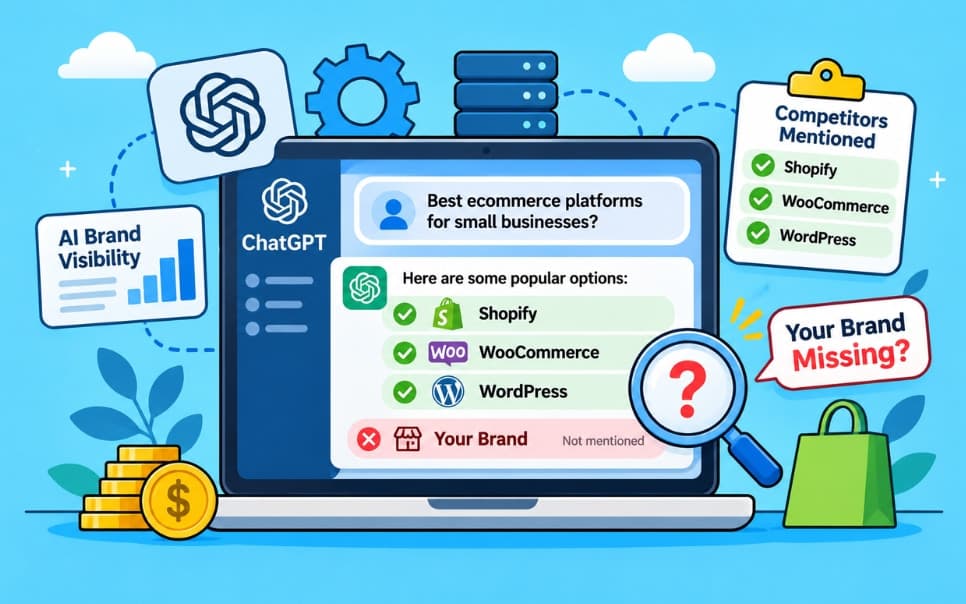
A client sent me a screenshot last month.
Three competitors. Named in ChatGPT. Their brand: not there once.
Their question: 'Did we do something wrong?'
My answer: not wrong. Just behind.
ChatGPT does not cite brands randomly. It follows a specific set of signals when deciding which companies to include in a response. If your competitors are appearing and you are not, their content is producing those signals more reliably than yours.
The good news: those signals are identifiable, measurable, and buildable.
Here is exactly what is happening and how to fix it.
Key Takeaways
→ The gap is a content signals gap, not a brand size gap.
→ The four signals with the highest citation lift: named statistics (+41%), expert quotes (+41%), inline citations (+28%), content freshness (76.4% of cited pages).
→ Domain authority matters: 0.65 correlation with AI citation frequency.
→ Brand mentions on third-party sites matter more than backlinks. Brands with high web mention volume are 3x more likely to appear in AI Overviews.
→ Most brands can close the gap within 60 to 90 days. Start with your top 10 ranking pages.
Why Does ChatGPT Cite Some Brands and Ignore Others?
The starting point is understanding how a large language model decides what to include in a response.
When a user asks ChatGPT which investment platform to use, or which marketing agency in India has the best track record, it is not running a search. It is drawing on patterns from its training data, combined with live web retrieval, to identify which sources are treated as credible and relevant.
There are two distinct mechanisms. Both matter.
Mechanism 1 - Training data citation
The base version of ChatGPT was trained on a large corpus of web content. Brands that appeared frequently, consistently, and with high credibility signals in that corpus are more likely to appear in responses even when browsing is off.
This is a long-term authority effect. Competitors who have been producing well-sourced, regularly updated content for several years have this advantage by default.
Mechanism 2 - Retrieval-augmented generation (RAG)
When ChatGPT uses its browsing function, or when platforms like Perplexity run queries, they retrieve live web content and use it to generate a response.
The pages that appear are drawn directly from retrieved results. The same signals that help a page rank on Google help it get retrieved here. But there is an additional layer: the content must contain specific citation signals that make it likely to be quoted, not just consulted.
Your competitors are not cited because ChatGPT likes them more.They are cited because their content produces more of the signals that AI systems use to identify citable sources.This is fixable. Those signals are not proprietary. They are documented, measurable, and deployable on your existing content.
What Signals Determine Which Brands Get Cited by AI?
The most comprehensive published research on this is the Princeton GEO-Bench study (Aggarwal et al., KDD 2024), which ran 10,000 queries across multiple LLMs and measured the citation lift produced by specific content changes.
Here is what they found.
|
Signal |
What It Means |
Citation Lift |
|
Named statistics with source attribution |
A specific, quantified claim attributed to a named institution: 'India's bond market reached $2.7 trillion in 2025 (RBI, 2026)' rather than 'bond investment is growing rapidly' |
+41% |
|
Expert quotes with full attribution |
A direct quote from a named individual with their title and organisation stated. Not 'experts say...' — a named person. |
+41% |
|
Inline citations (hyperlinked claims) |
The source hyperlink appears within the sentence making the claim, not just in a references section at the bottom of the page. |
+28% |
|
Content freshness |
The page carries a visible last-updated date and has been updated within the past 30 days. |
Present in 76.4% of cited pages |
Source: Aggarwal et al., 'GEO: Generative Engine Optimization', ACM KDD 2024 - arxiv.org/abs/2311.09735
Beyond content signals, two structural factors determine your baseline citation probability.
|
Structural Factor |
How It Affects AI Citation |
|
Domain authority |
0.65 correlation between domain authority and citation frequency across LLMs. High-authority domains are treated as more credible and cited more often for competitive queries. |
|
Organic search ranking |
99.5% of pages cited in Google's AI Overviews already rank in organic search. Pages that do not rank are unlikely to be retrieved by RAG systems regardless of content quality. |
|
Brand web mentions on third-party sites |
Brand mentions across news sites, industry publications, and review platforms correlate 3x more strongly with AI visibility than backlinks. |
Sources: Ahrefs 2026 | EliteContentMarketer - GEO & AEO Statistics 2026
How Do I Audit My Current AI Visibility?
Before building a fix, you need a baseline.
Here is how to establish one.
Step 1 - Test your brand directly
Open ChatGPT, Perplexity, and Gemini.
Run the 10 to 15 queries your target customers are most likely to ask in your category.
Record whether your brand appears. Where it appears. Whether it is named positively, neutrally, or not at all.
Do the same for your top three competitors.
This is your qualitative baseline.
Step 2 - Use an AI visibility tracking tool
Several tools now track AI citation systematically across platforms and query sets.
The leading options in 2026: Semrush AI Visibility, Otterly.ai, and BrandMentions AI Monitor.
Each runs recurring query batches and reports your citation share versus competitors over time.
Step 3 - Audit your content against citation signals
Pull your top 20 ranking pages from Google Search Console.
For each page, check:
→ At least 3 named statistics with source attributions
→ At least 1 expert quote with full name, title, and organisation
→ Claims hyperlinked to primary sources within the sentence
→ A visible 'Last updated' date
|
Audit Checkpoint |
What to Look For |
|
Statistics present |
At least 3 named statistics per page with source and year. Generic claims without data score 0. |
|
Expert attribution |
At least 1 direct quote from a named expert, with title and institution. 'Experts say' scores 0. |
|
Inline citations |
Claims hyperlinked to the primary source within the sentence. |
|
Freshness |
Page carries a visible 'Last updated' date. Pages last updated more than 90 days ago are low priority. |
|
Answer structure (AEO overlap) |
Section headings are question-format. Each question is followed by a 40 to 60 word direct answer. |
|
Domain authority baseline |
Compare your DA versus the competitors being cited. A gap of 20+ points is a structural barrier that takes time to close. |
Why Are My Competitors Appearing and Not Me? The Most Common Gaps.
I see four root causes in almost every audit I run.
Sometimes it is more than one.
|
Root Cause |
What It Looks Like |
Fix Timeline |
|
Content lacks evidence signals |
Well-written content that makes claims without statistics, named sources, or inline citations. Reads professionally but AI systems have no anchors to cite. |
4 to 8 weeks. Add statistics and expert quotes to existing high-authority pages. |
|
Content is structurally outdated |
Evergreen pages published once, never updated. No visible date. |
2 to 4 weeks once a freshness calendar is running. |
|
Domain authority gap |
Competitors have spent more years building backlinks and domain trust. |
6 to 18 months to close significantly. Content signals can partially offset this in the short term. |
|
Low brand mention volume |
Your brand is not discussed on third-party sites: industry publications, news outlets, forums, review platforms. |
3 to 6 months to build meaningfully. |
The fastest win is almost always fixing content signals on existing high-authority pages.Adding named statistics and expert quotes to your top 10 ranking pages can produce measurable citation lift within one model update cycle — typically 4 to 8 weeks.
What Specific Changes Will Get My Brand Cited by ChatGPT?
Here are the changes with the highest documented impact on AI citation. Ordered by speed of result and ease of implementation.
Priority 1 - Add named statistics to every major claim
Go through your top 10 highest-authority pages.
Identify every claim that could be supported by a number.
Replace general statements with specific, attributed data points.
|
Before |
After |
|
'The Indian bond market has grown significantly in recent years.' |
'India's bond market reached $2.7 trillion in 2025, making it one of the fastest-growing fixed-income markets in Asia (Reserve Bank of India, 2026).' |
Priority 2 - Add expert quotes with full attribution
Identify credible named sources relevant to your category: regulators, academics, industry associations, or well-known practitioners.
Include a direct quote with the speaker's full name, title, and organisation.
A paraphrase without attribution does not produce citation lift.
Priority 3 - Hyperlink your claims to primary sources inline
Every statistic and every attributed claim should carry a hyperlink to its primary source, placed within the sentence itself.
A 'References' section at the bottom of the page is significantly less effective than an inline citation.
Think of how academic papers treat citations, not how general web content does.
Priority 4 - Add a visible last-updated date and refresh priority pages
76.4% of pages cited by AI systems were updated within the prior 30 days at the time of citation.
Add a visible 'Last updated:' field to every priority page.
Then create a rolling calendar: your top 20 pages should each be updated at least once per month.
Even small substantive updates count.
Source: Princeton GEO-Bench (KDD 2024)
Priority 5 - Build brand mentions on third-party sites
AI systems build their understanding of a brand's authority from the breadth of mentions across the web, not just from your own site.
The channels with the highest impact on AI citation:
→ Industry publications and trade press
→ News coverage (even brief mentions in roundups count)
→ Review platforms in your category
→ Reddit and Quora threads where your category is discussed
→ Contributed articles with your brand name and a backlink
Priority 6 - Strengthen your SEO foundation
Domain authority remains the strongest structural predictor of AI citation.
If you are not ranking on Google for the queries where you want AI visibility, you are unlikely to get it.
A parallel SEO programme — technical health, backlink building, content depth — is the long-term lever that makes every other GEO tactic more effective over time.
How Long Does It Take to Start Appearing in ChatGPT Responses?
The timeline depends on which citation mechanism is in play and which gap you are closing.
|
Platform and Mechanism |
Expected Timeline After Changes |
What Drives the Speed |
|
Perplexity (live retrieval) |
Days to 2 weeks after re-indexing |
Perplexity uses live Bing-indexed results. Once your updated page is crawled, it enters the retrieval pool immediately. |
|
ChatGPT with browsing (live retrieval) |
Days to 4 weeks after re-indexing |
Bing-powered retrieval. Updated pages with strong signals can appear quickly. |
|
ChatGPT base model (training data) |
Next model update cycle — typically 2 to 6 months |
Training-based citation reflects the state of the web when the model was last trained. |
|
Google AI Overviews (AEO layer) |
1 to 4 weeks after re-indexing |
Google's AI Overview selection updates frequently. Strong AEO content on already-ranking pages can move into citation range within weeks. |
|
Domain authority improvement |
6 to 18 months |
Authority builds slowly through sustained link acquisition and brand mention growth. |
The practical implication: content signal improvements are the fastest levers.
A brand that implements these on its top 10 pages should expect measurable AI citation lift within 4 to 8 weeks on retrieval-based platforms.
Sources: Semrush AI referral traffic study | Princeton GEO-Bench (KDD 2024)
How Has This Worked for a Brand in Practice?
GoldenPi is India's leading retail bond investment platform.
When Bee Online began working with GoldenPi six years ago, the engagement started as an SEO programme. GoldenPi ranked well for bond investment queries. But as AI platforms emerged as significant discovery surfaces, the brand was largely invisible on them.
We followed the same sequence described in this article. We audited GoldenPi's highest-authority pages against citation signal criteria. Every major content claim was updated with SEBI-aligned statistics, named sources, and inline hyperlinks. Expert attribution was added from senior professionals in the fixed-income space. A freshness calendar was implemented across the top 30 pages, with each updated on a rolling monthly cycle.
Within four months, GoldenPi became the most cited bond-tech brand in India across ChatGPT, Google AI Overviews, AI Mode, and Gemini.
The GEO layer converted existing organic authority into AI visibility.
|
Metric |
Outcome |
|
AI citation share - bond-tech category, India |
#1 across ChatGPT, AI Overview, AI Mode, Gemini |
|
Monthly LLM-cited audience |
5x growth in four months |
|
Domain authority - bond-tech category, India |
#1 clear of all named competitors |
|
Paid order volume |
6x growth in 24 months |
If your competitors are appearing in ChatGPT and you are not, the gap is closable.Bee Online runs GEO programmes for brands across India, Canada, and the US.We audit your current AI citation baseline, identify the exact content signal gaps on your highest-authority pages, and implement the changes that move your brand into the citation pool.Request your free AI citation audit:
Frequently Asked Questions
Does ChatGPT show which pages it is currently drawing from for my category?
Not directly. ChatGPT does not expose its citation sources in standard responses. However, enabling the browsing function and asking category queries will show you the sources it retrieves and cites in real time.
For systematic tracking across query sets and platforms, tools like Semrush AI Visibility and Otterly.ai run automated query batches and report citation share over time.
My brand has good SEO. Why am I still not appearing in ChatGPT?
Good SEO rank is a prerequisite, not a guarantee.
99.5% of pages cited in AI Overviews rank in organic search. But the reverse is not true: ranking does not automatically produce AI citation.
The additional requirement is the content signals layer — statistics with named sources, expert quotes, inline citations, and freshness.
A well-ranked page that lacks these signals will be retrieved but passed over in favour of a page that has them.
Source: EliteContentMarketer - GEO & AEO Statistics 2026
Will GEO changes hurt my existing SEO performance?
No.
Adding statistics, expert quotes, inline citations, and freshness updates are additive improvements to existing content. They do not change URL structure, alter keyword targeting, or create duplicate content.
All of these changes are consistent with Google's E-E-A-T guidelines and are likely to improve rather than harm existing rankings.
My competitors are much larger brands. Is AI citation just a function of brand size?
Brand size correlates with AI citation primarily because larger brands tend to have higher domain authority and more brand mentions across the web.
But brand size itself is not the signal — domain authority and mention volume are.
There are many smaller brands that appear more frequently in AI responses than larger competitors because their content quality, citation signals, and freshness are superior.
A focused GEO programme can produce measurable results, particularly on retrieval-based platforms like Perplexity, faster than a domain authority campaign.
Should I create entirely new content for GEO, or improve what I have?
Start with what you have.
Your existing high-authority pages already have the ranking signals that put them in the AI retrieval pool. Adding the citation signals layer to these pages is faster and produces a better return than creating new pages from scratch.
New content is valuable for GEO when it targets query types your current content does not cover — particularly question-format and comparison queries.
But for the first 60 to 90 days of a GEO programme, improving existing high-rank pages is the higher-priority activity.
How does Bee Online measure GEO success for its clients?
We track AI citation share across ChatGPT, Perplexity, Gemini, and Google AI Overviews using Semrush AI Visibility and Otterly.ai.
We run a fixed set of category queries for each client on a weekly basis and report citation rate, citation position, and citation sentiment over time.
We also track AI referral traffic in Google Analytics 4 (source/medium: perplexity.ai, chatgpt.com, gemini.google.com) to measure whether AI visibility is converting into sessions and leads.