And Which Does Your Business Actually Need in 2026?
Zero-click searches now account for 64.82% of all Google searches. AI Overviews appear in up to 25% of queries.Ranking on Google is no longer the same as getting found. Here is what you need to do about it.Source: SparkToro / Semrush, 2026
For years, the SEO advice sounded something like this:
Write for keywords.
Build backlinks.
Get to page one.
That still works.
But the search results page has changed around us. And the brands earning the most from search are now extracting value from more than one surface.
If you have been running an SEO programme for any length of time, you have almost certainly come across AEO and GEO. Answer Engine Optimisation. Generative Engine Optimisation. They appear in almost every industry article about search in 2026, usually with some version of the claim that SEO is dying.
It is not.
But understanding how SEO, AEO, and GEO differ — and where they work together — is no longer optional for brands that want to stay visible.
Here is a clear breakdown of each.
Key Takeaways
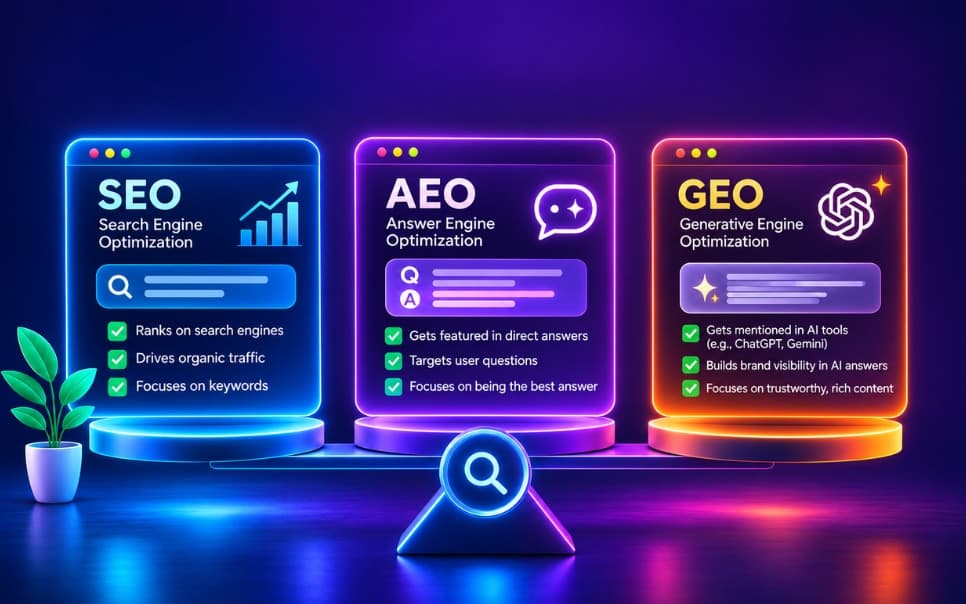
→ SEO targets Google's blue-link rankings and drives organic click traffic. It is the foundation of every other search discipline.
→ AEO targets Google's AI Overviews, featured snippets, PAA, and voice search. It gets your content read aloud or summarised instead of clicked.
→ GEO targets ChatGPT, Perplexity, Gemini, and other LLMs. It gets your brand cited when users research your category in AI chat.
→ All three share the same foundation: E-E-A-T, content quality, and domain authority.
→ For brands with established SEO, AEO and GEO are an additional layer — not a replacement. The tweaks are targeted and fast to implement on already-ranking pages.
What Is SEO — and What Does It Do?
Search Engine Optimisation is the practice of improving a website's visibility in Google's organic (unpaid) search results.
It covers three interconnected disciplines:
→ Technical SEO: site structure, indexation, page speed, crawlability
→ On-page SEO: content quality, keyword targeting, metadata
→ Off-page SEO: backlinks, domain authority, brand signals
The goal is to rank as high as possible for queries your target audience is searching, so users click through to your site.
SEO still delivers. Google commands 91.25% of global search share. Organic search accounts for 33% of web traffic across major industries.
The argument is not that SEO has stopped working.
It is that the search results page has changed around it, and the brands earning the most from search are now extracting value from more than one surface.
|
SEO Targets |
What Good SEO Produces |
Primary Metric |
|
Google's 10 blue-link organic results for a query |
High rankings for relevant keywords, sending click traffic to the site |
Organic sessions, keyword rank position |
|
Google Images, Maps, Shopping, News |
Visibility in vertical search experiences for relevant queries |
Impression share, click-through rate |
|
Local search (Google Business Profile) |
Prominent placement in maps and local pack results for geo-specific queries |
Local pack appearances, direction requests |
|
Core Web Vitals and technical performance |
Pages meet Google's threshold for eligibility in all search features |
CWV scores, index coverage, crawl health |
What Is AEO — and How Does It Differ from SEO?
Answer Engine Optimisation is the practice of formatting and structuring content so that it can be selected as the direct answer to a query — rather than simply ranked as a result to click through to.
AEO targets surfaces that extract and present information without necessarily sending traffic:
→ Google's AI Overviews
→ Featured snippets
→ People Also Ask boxes
→ Voice search responses
The distinction from SEO is one of intent and format.
SEO asks: how do I rank for this query?
AEO asks: how do I become the answer to this query?
The two are not mutually exclusive. Pages that rank well are significantly more likely to be selected as the answer. But they require different things from your content.
|
SEO |
AEO |
|
|
Primary goal |
Rank as high as possible for a keyword |
Be selected as the direct answer to a question |
|
Target surfaces |
Google organic results (positions 1-10) |
AI Overviews, featured snippets, PAA boxes, voice search |
|
Content format |
Long-form, comprehensive, narrative — rewards depth and coverage |
Question-format headings, 40-60 word direct answers, FAQ sections with schema |
|
Structured data |
Article, BreadcrumbList, Product schema |
FAQPage, HowTo, Speakable schema — explicitly signals Q&A pairs to extractors |
|
Traffic outcome |
User clicks through to the site |
User receives the answer on the results page — may not click (zero-click) |
|
Prerequisite |
Technical health, backlinks, keyword targeting |
Good SEO rank is strongly preferred — 38% of AI Overview citations come from top-10 pages |
Sources: Ahrefs (2026) | SparkToro (2026)
Why AEO matters even when it produces zero clicks:being selected as Google's answer to a question is one of the strongest brand awareness signals in search.Users who encounter your brand in an AI Overview arrive on your site with significantly higher purchase intent.
What Is GEO — and How Does It Differ from Both SEO and AEO?
Generative Engine Optimisation is the practice of making your content citable by large language models: ChatGPT, Perplexity, Gemini, Claude, and similar platforms.
When a user asks an AI chatbot which bond platform they should use, or what the best fintech options are in India, GEO determines whether your brand appears in the response.
GEO differs from both SEO and AEO in its mechanism.
SEO and AEO operate primarily within Google's ecosystem.
GEO operates across every AI platform that ingests web content.
And it is based on a fundamentally different signal set.
LLMs do not rank pages. They cite passages. The question is not whether your page is the best result — it is whether your page contains the kind of content that a language model is likely to repeat.
|
AEO |
GEO |
|
|
Target platform |
Google (AI Overviews, snippets, voice) |
ChatGPT, Perplexity, Gemini, Claude, Bing Copilot |
|
How content is selected |
Google selects extractable answer from indexed, ranked pages |
LLM selects citable passage based on credibility signals — statistics, expert quotes, inline citations, freshness |
|
Key content signals |
Question headings, direct answer paragraphs, FAQPage schema |
Named statistics (+41% citation lift), expert quotes (+41%), inline citations (+28%), freshness — 76.4% of cited pages updated within 30 days |
|
Traffic outcome |
Often zero-click, but strong brand visibility on Google |
AI referral traffic growing 527% YoY; converts 31% better than standard organic |
|
Growth trajectory |
AI Overviews now appear in 13-25% of Google searches |
ChatGPT: 900M weekly active users (Feb 2026). Perplexity: 243% YoY growth |
Sources: Princeton GEO-Bench (KDD 2024) | Semrush (2025) | OpenAI (Feb 2026)
How Do SEO, AEO, and GEO Compare Across Every Key Dimension?
The three disciplines are more complementary than they are competing.
The clearest way to understand their relationship is to see where they share signals and where they diverge.
|
Dimension |
SEO |
AEO |
GEO |
|
Primary goal |
Rank on Google's results page |
Be the answer Google extracts |
Be cited by AI chatbots |
|
Surfaces targeted |
Organic results (Google) |
AI Overviews, snippets, PAA, voice |
ChatGPT, Perplexity, Gemini, Bing AI |
|
Content depth required |
High — comprehensive pages rank |
High depth + short extracted answers |
High depth + evidence layer (stats, quotes) |
|
Structured data |
Article, Product, Breadcrumb |
FAQPage, HowTo, Speakable |
Schema helps but is secondary to citation signals |
|
E-E-A-T signals |
Core ranking factor |
Core eligibility factor for AI Overviews |
Domain authority correlates 0.65 with citation frequency |
|
Backlinks |
Critical |
Indirect — backlinks build domain authority which helps snippet selection |
Indirect — brand web mentions correlate 3x more with AI visibility than backlinks |
|
Content freshness |
Valued for time-sensitive topics |
Valued — stale pages less likely to be surfaced in AI Overviews |
Critical — 76.4% of AI-cited pages updated within prior 30 days |
|
Traffic model |
Click-based |
Often zero-click — visibility without a session |
AI referral traffic — growing rapidly, high conversion |
Sources: Ahrefs (2025, 2026) | Semrush (2025) | Princeton GEO-Bench (KDD 2024)
What Do SEO, AEO, and GEO Have in Common?
Here is the most important point in this article.
All three disciplines share the same underlying foundation.
This is why brands with strong SEO are not starting from zero when they adopt AEO and GEO.
|
Shared Foundation |
Why It Matters for SEO |
Why It Matters for AEO |
Why It Matters for GEO |
|
High-quality, comprehensive content |
Ranks for broader keyword sets |
Gives extractors multiple answer candidates to select from |
Longer pages provide more citable passages |
|
E-E-A-T (Experience, Expertise, Authoritativeness, Trust) |
Core Google ranking factor |
AI Overview selection weights E-E-A-T heavily |
0.65 domain authority / citation frequency correlation across LLMs |
|
Technical accessibility (fast, clean, fully indexed) |
Prerequisite for ranking eligibility |
Prerequisite for AI Overview eligibility |
AI crawlers follow the same rules as Googlebot — blocked = invisible |
|
Brand authority and web mentions |
Supports domain authority growth |
Builds overall trust profile for AI Overview selection |
Brand web mentions correlate 3x more strongly with AI citation than backlinks |
Practical implication: if your SEO is working — if you rank, earn backlinks, and produce authoritative content — you have already built the infrastructure that AEO and GEO require.99.5% of pages cited in Google AI Overviews already rank in organic search. Your rankings are the entry ticket.Source: SEOWorks, 2026
If You Have Strong SEO, What Exactly Do You Need to Add for AEO and GEO?
The gap between strong SEO and full AEO and GEO coverage is not a strategic overhaul.
It is a formatting layer (AEO) and a credibility signals layer (GEO) applied to pages that already have the authority to be selected.
These are targeted additions, not rebuilds.
For AEO: format your existing content for extraction
|
What to Add |
Why It Works |
|
Reformat section headings as questions ('What is the best way to invest in bonds?') |
Aligns with the question-answer format that Google's extractor scans for |
|
Write a 40-60 word direct answer immediately after each question heading |
A self-contained answer that can be read aloud or displayed in a snippet without further context |
|
Add a dedicated FAQ section (6-8 questions) at the end of the page |
Google's PAA boxes and voice assistants preferentially draw from explicit Q&A content |
|
Add FAQPage JSON-LD schema markup to the CMS |
Explicitly signals Q&A pairs to Google's crawler, increasing selection probability |
|
Move the primary answer to the first 30% of the page |
44% of ChatGPT citations come from the first third of the page |
For GEO: add the evidence layer that LLMs cite
|
What to Add |
Citation Lift (Princeton GEO-Bench, KDD 2024) |
|
Named statistics with source attribution inline |
+41% |
|
Expert quotes with full attribution: name, title, institution |
+41% |
|
Inline hyperlinks to primary sources within the sentence (not just a references section at the bottom) |
+28% |
|
Content freshness — visible 'Last updated' date, updated within rolling 30 days for priority pages |
Present in 76.4% of cited pages |
Source: Aggarwal et al., 'GEO: Generative Engine Optimization', ACM KDD 2024
Which Does Your Business Need — SEO, AEO, GEO, or All Three?
The honest answer for almost every category: all three. In that order.
But the proportions of effort differ significantly depending on where you are starting from.
|
Your Starting Point |
Priority |
|
No SEO programme, new site |
SEO first — build technical health, domain authority, and quality content before anything else. AEO and GEO will not work without this foundation. |
|
SEO programme underway, early stage (6-18 months) |
Continue SEO as primary. Begin AEO on your 5-10 highest-performing pages. GEO: ensure content is technically accessible to AI crawlers. |
|
Established SEO, ranking well in target categories |
Add AEO and GEO as active layers on top of existing programme. The authority is already there — the gap is formatting (AEO) and citation signals (GEO). |
|
SEO mature, brand visible on Google, want AI visibility |
GEO-first from here: systematic statistics and expert quote layer on priority pages, freshness calendar, AI citation tracking via Semrush AI Visibility or Otterly.ai. |
The case for acting now: AI referral traffic is growing at 527% year-over-year.
The brands being cited by ChatGPT and Perplexity today are disproportionately the ones that will be recommended by default as these platforms refine their responses over time.
First-mover advantage is real in GEO.
Source: Semrush (2025)
How Does This Work in Practice? A Bee Online Case Study.
GoldenPi is India's leading retail bond investment platform.
When Bee Online began working with GoldenPi six years ago, the engagement started as an SEO programme. GoldenPi ranked well for bond investment queries. But as AI platforms emerged as significant discovery surfaces, the brand was largely invisible on them.
We layered AEO and GEO onto the existing SEO foundation. Question-format headings. Direct answer paragraphs. FAQPage schema. Then the GEO layer: named statistics, expert attribution, inline citations, and a rolling freshness calendar across the top 30 pages.
Within four months, GoldenPi became the most cited bond-tech brand in India across ChatGPT, Google AI Overviews, AI Mode, and Gemini.
|
Metric |
Outcome |
|
AI citation share - bond-tech category, India |
#1 across ChatGPT, AI Overview, AI Mode, Gemini |
|
Monthly LLM-cited audience |
5x growth in four months |
|
Domain authority - bond-tech category, India |
#1 — clear of all named competitors |
|
Paid order volume |
6x growth in 24 months |
Bee Online runs SEO, AEO, and GEO programmes for brands across India, Canada, and the US.We audit your current search and AI visibility baseline, identify the exact gaps, and implement the changes that build visibility across all three surfaces.Request your free SEO + AEO audit:
Frequently Asked Questions
Is SEO dead? Should I stop investing in it?
No. SEO is not dead.
The search results page has changed around it. AI Overviews, featured snippets, and zero-click searches have reduced the percentage of queries that produce a standard blue-link click. But Google still commands 91.25% of global search share, and organic search still drives 33% of web traffic across major industries.
More importantly: ranking on Google is the prerequisite for appearing in AI Overviews and for being retrieved by AI chatbots. 99.5% of pages cited in AI Overviews already rank in organic search.
The question is not SEO versus AEO or GEO. The question is SEO plus AEO and GEO.
Do I need a different agency for SEO, AEO, and GEO?
Not ideally. The three disciplines share the same content and authority foundation. Splitting them across agencies creates coordination risk and inconsistency.
The best agencies in India in 2026 deliver all three with each layer built on the one below it. If your current agency is delivering SEO but not AEO or GEO, the question to ask them is: when are you adding these layers, and how will you measure the results?
How is AEO different from just doing better SEO?
Better SEO aims to rank higher in blue-link results. AEO adds a formatting layer designed specifically for extraction.
The difference is in the content structure. AEO requires question-format headings with a direct 40 to 60 word answer immediately following each one. It requires FAQPage schema markup. It requires that the primary answer be in the first 30% of the page.
These changes are compatible with strong SEO — they typically improve rankings as well as snippet selection — but they are not the same thing.
Is GEO the same as content marketing?
No. Content marketing is a strategy for building audience and authority through valuable content. GEO is a signals layer applied to existing content to make it citable by AI systems.
GEO does not require new content. It requires that existing high-authority pages contain specific, attributable, structured information — named statistics, expert quotes, inline citations, and freshness updates.
You can run a GEO programme on content that was written years ago.
How quickly can I expect AEO and GEO to produce results?
AEO (featured snippets and AI Overviews): 1 to 4 weeks after implementation and re-indexing on pages that already rank.
GEO on retrieval-based platforms (Perplexity, ChatGPT with browsing): days to 4 weeks after re-indexing.
GEO on base-model ChatGPT (training data): next model update cycle, typically 2 to 6 months.
The fastest results come from pages that already rank well and are adding the citation signals layer. This is why implementing on existing high-authority pages is always the first step.
What is the minimum viable investment for AEO and GEO?
The minimum viable investment for AEO is to audit your top 10 ranking pages and implement question-format headings, direct answer paragraphs, and FAQPage schema. This is a one-time content update that an experienced SEO team can complete in 2 to 4 weeks.
The minimum viable investment for GEO is to add named statistics with source attribution and at least one expert quote to each of those same 10 pages, then establish a monthly freshness update calendar.
Both can be run on top of an existing SEO programme without additional infrastructure. The investment is in the content update and the ongoing freshness calendar, not in new tools or platforms.